
Outfit Ideas
Closet Full of Clothes, Nothing to Wear? Try This
A full closet can still feel empty. Name the day's constraints, change one piece in an outfit you trust, and stop shopping from the stuck feeling.
In this guide
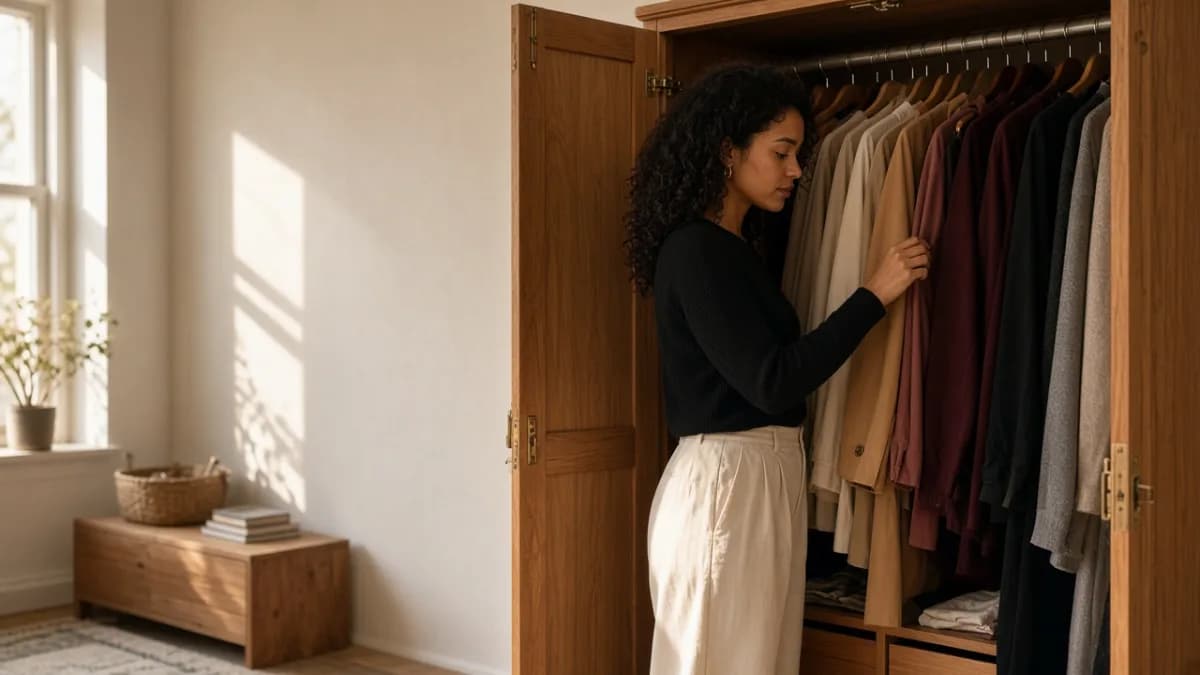
A closet can be full and still feel empty. Sometimes the missing thing is a visible, wearable combination for the day in front of you. Sometimes your body, climate, work, or preferences have changed and the clothes no longer meet that need. Check which problem you have before buying or blaming yourself.
The feeling can show up on ordinary mornings: you open the doors, recognize the same five outfits, and reject the rest as “not right” without trying them. Another top will not solve an outfit problem if the missing piece is a comfortable bottom, a suitable shoe, or a clear brief.
Name the actual problem
“Nothing to wear” hides several different problems. They need different next steps.
| What is actually going on | What helps |
|---|---|
| You cannot see most of what you own | Make a small set visible — on the bed, on hangers, or in a digital wardrobe |
| You can see it, but nothing matches the day | Write the day's constraints before you look at clothes |
| The same five outfits are the only ones that feel safe | Change one variable in a known outfit, not the whole look |
| Clothes do not fit or are uncomfortable | Those pieces cannot solve this morning; set them aside |
| You want a new identity, not an outfit | That is a longer style question; do not solve it at 7:40 a.m. |
If the clothes physically do not fit, no styling method will help today. If they do fit and you still freeze, the next sections are for you.
Shrink the closet to one brief
Do not start by pulling everything out. Write one sentence about the day: where you will be, how much you will walk, how warm it will be, and any hard rule (“no heels,” “needs a pocket,” “I want to wear these trousers”).
Then take out only the pieces that could satisfy that sentence. A full rail is noisy. A pile of eight candidates is a decision.
Example brief: “Indoor work day, ten-minute walk, I want to wear the navy trousers, shoes I can commute in.” That already excludes the heavy coat, the dress, and the shoes you cannot walk in. The closet did not get smaller. The question did.
Use a known outfit as a base, then change one thing
When you are stuck, do not invent a look from zero. Recreate an outfit you already trust, then change a single part.
- Keep the trousers and shoes; change the top.
- Keep the dress; change the layer.
- Keep the whole combination; change the bag or jewelry.
This is faster than hunting for a completely new personality in the hangers. It also uses more of the closet over time, because neglected pieces get a defined job: they are the one change.
The longer method lives in how to create outfits from clothes you already own. On a stuck morning, one change is enough.
Look for clothes you forgot, not clothes you lack
A full closet often contains a jacket, a shirt, or a pair of shoes you last wore months ago. You skip them because they are behind something, similar to a safer piece, or associated with an occasion that has passed.
Put three neglected pieces on the bed next to today's brief. Ask whether any of them can be the “one change.” If not, they go back. You have not failed. You have ruled them out for this day instead of vaguely rejecting the whole closet.
A photographed wardrobe helps because forgotten pieces show up beside the ones you always wear. In Fashion Frame, that record lives in Wardrobe; you can then ask the Home AI stylist to use a neglected piece on purpose: “Include the sand jacket. Keep the outfit commute-friendly.”
Do not shop from the stuck feeling
When the decision is due in twenty minutes, it is hard to separate an urgent wish for something different from a genuine wardrobe gap. Get dressed in a workable fallback first, then revisit the purchase when you can name what is missing.
If you still want to shop later, wait until you can name the gap in one line after a real week: “I have no shoe I can walk in that also looks tidy with these trousers.” That is a brief. “I have nothing to wear” is not.
A capsule built from clothes you already own is one way to test whether the gap is real.
Make the next morning easier
Once you have a wearable outfit, save it. A named look in Fashion Frame, or a photo in your camera roll, is how you stop solving the same Tuesday twice. If the week is busy, plan the next few days in one sitting.
The goal is not a more impressive closet. It is a shorter path from the rail to the door.
Frequently asked questions
Why do I feel like I have nothing to wear when my closet is full?
Usually because only a few combinations feel safe, or because the day's constraints were never named. The unused clothes are often unseen, uncomfortable, or waiting for a different occasion.
Should I get rid of clothes to fix this?
Not as the first step. Make a smaller working set for the week. If pieces never enter that set and you do not miss them, then you have evidence. Emptying the closet in one afternoon often creates regret without creating outfits.
Can an AI stylist help with this?
Yes, if it can see the clothes you own and you give it a specific brief. It cannot invent comfort or fit. Ask it to use one neglected piece, or to keep an anchor you already trust.
Put the guide into practice
Start with your own wardrobe.
Ask the Home stylist for an outfit using the pieces you have photographed.
Try Fashion FrameContinue reading
Outfit Ideas
How to Create Outfits From Clothes You Already Own
When you have plenty of clothes but nothing feels right, start with one anchor piece. This method turns individual garments into repeatable outfits.
AI Fashion
What Is an AI Personal Stylist?
An AI personal stylist uses your wardrobe, preferences, and the occasion to suggest outfits. Here is what it can do, what it cannot, and how to ask it well.
Wardrobe
What Is a Digital Wardrobe?
A digital wardrobe is a visual record of the clothes you own. Here is what belongs in one, how to start small, and how it helps you get dressed.